
January 13, 2026: Small, local airports critical in a storm, wildfire, or an earthquake
By David Ferman and Jon Spalding
Senior governments in Canada at both the provincial and federal levels need to re-assess the value proposition provided by local and regional airports in the context of the growing threat of natural disasters.
Over 600 Canadian communities depend on community and regional airports that receive modest senior government financial support, for critical emergency response as well as passenger and freight transportation. Critically, these airports require funding from other sources than senior government in order to sustain basic airport infrastructure. At the same time, the frequency of naturally occurring emergencies – floods, wildfires, earthquakes – is trending upwards
Airports were critical to the development of Canada’s vast hinterland and supporting remote communities. Small regional airports and an extensive network of bush plane services enabled the development of industry, employment, and communities throughout the country, and supporting existing communities. The last 50 or more years of road and rail development has supplanted the primacy of regional and local airports as critical transportation infrastructure. However, with the increasing frequency of significant natural “disaster” events, including flooding and wildfires, and the resulting disruption of surface transportation networks, there have been several examples of Canadian aviation becoming the primary infrastructure for the critical movement of people, goods and services. This is at the same time as provincial and federal governments have largely turned their attention from smaller aerodromes.
The recent evacuation of Kashechewan First Nation is an immediate example of this. It is a fly-in community and a Cree First Nation of about 2,300. It has winter road access depending on weather, but no four-season road access. The community has to evacuate because its water treatment system failed in late 2025. Moving 2,000 people from a small airport in winter is difficult.
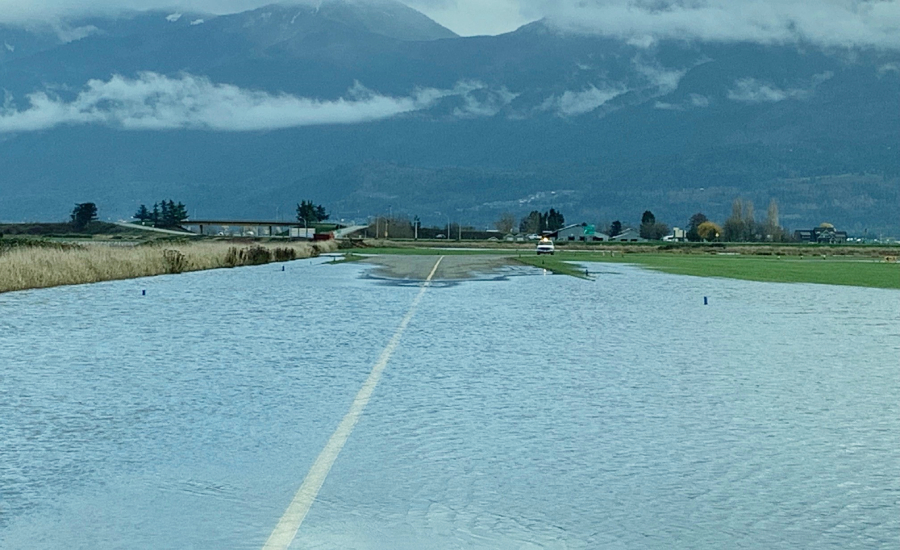
In British Columbia, 2021 flooding wiped out highways and rail connection between the Lower Mainland and the Southern Interior. An ad hoc and largely volunteer airlift between the regional airports at Abbotsford, Chilliwack, Hope, and Merritt provided a vital and efficient workaround for critical emergency response movement of people, goods and services. Similarly, in 2023, the Cameron Lake Wildfire on south central Vancouver Island cut off the West Coast communities of Port Alberni, Bamfield, Ucluelet, and Tofino from the larger communities on the east coast of Vancouver Island. The Qualicum Beach Airport provided a base for air service to Port Alberni and Tofino for the better part of a week during the highway closures.
In the first few instances these seem to be isolated events, yet now in 2025 similar flooding – though on a smaller scale – has again blocked highways in the Fraser Valley. In 2024 another wildfire near Cameron Lake burned out of control, this time without highway closures. A significant proportion of communities in the province experience the effect of wildfires annually. In BC, climate predictors note that the frequency and severity of atmospheric rivers linked to flooding are on the increase, and that the risk of wildfires is generally recognized as increasing year over year. In fact, the loss of forests due to wildfires in one season has been shown to increase the danger of floods in the next.
Beyond the increasingly common flooding and wildfire events, the Province of BC published a disaster and climate risk assessment in October 2025 anticipating an earthquake with a magnitude of 9.0 occurring off Vancouver Island – the likelihood of such an extreme event is between two to 10 per cent within the next 30 years – resulting in more than 3,400 fatalities and more than 10,000 injuries.
One might draw the conclusion that investing in critical infrastructure, including local and regional airports, as part of any emergency climate response strategy should be part of our security plans and infrastructure budgets.
Unlike our international airports, local and regional airports are generally owned and operated by local governments, who face cost downloads from senior government and expanding demands for investment in other community services. Today, many of those airports face significant financial hurdles as airport infrastructure (pavement, electrical, and subsurface drainage) now exceed their normal lifecycle. As the infrastructure degrades, the airports become more restricted in their ability to support emergency air response such as wildfire fighting or airlifts.
Senior governments in Canada at both the provincial and federal levels need to re-assess the value proposition provided by local and regional airports in the context of the growing threat of natural disasters – wildfire, flooding, and earthquakes – and commit to investing in that aspect of airport infrastructure. At the airports themselves, the airport masterplan and business plans, need to incorporate the opportunity to support emergency aviation activities, including fixed and rotor wing movements and parking, emergency response personnel accommodations and logistic facilities, fueling and other supplies, as well as maintenance.
David Ferman is OEI’s Director of Communications, and Jon Spalding is a Senior Associate. Both have worked with OEI for more than 10 years. OEI works with regional airports throughout Canada on a variety of issues, including long range physical and financial planning, economic and social impacts assessment, and community outreach.