
May 21, 2026: Preparing Regional Airports for this year’s wildfire season
By Jon Spalding
Wildfires are a natural part of the lifecycle of a forest ecosystem, but current data shows they’re becoming more frequent, more destructive, and more costly.[1] The area burned from wildfires continues to rise, even in regions once considered lower risk (because of wetter conditions) that are now showing flat or increasing fire trends.[2]
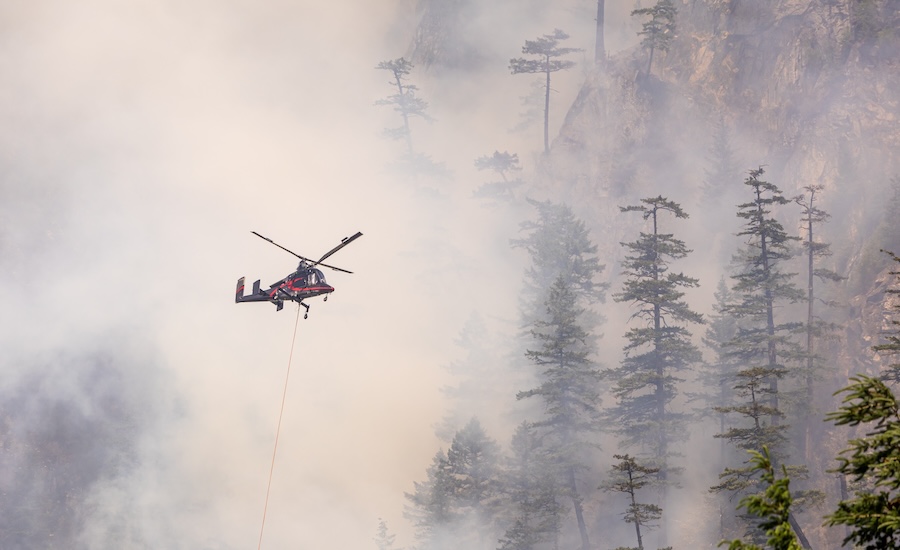
As aerial firefighting is a critical tool for wildlife management and highly effective at slowing, cooling, and confining flames, Canadian airport infrastructure is increasingly at the front lines of the wildfire response. This brief to airport managers outlines the requirements of local and regional airports to support wildfire operations.
Background
The wildfire forecast for 2026: a strong likelihood for warmer and drier conditions foreshadows increased risk of wildfires throughout much of Canada. Forecasters are projecting hot, dry conditions for spring and summer. Most wildfire experts are cautioning for an elevated wildfire risk during 2026.
A warm winter and ongoing droughts could elevate fire risk this season, says BC Wildfire Service expert Mike Flannigan. He says this year will be his “litmus test” for whether Canada’s wildfire seasons, already in uncharted territory and fueled by human-caused climate change, have entered a “new reality.”
“My narrative used to be, there will be bad fire years and there will be quiet years. I’m now beginning to think at a national scale, most years are going to be bad fire years,” says Flannigan, a professor of wildland fire at Thompson Rivers University in Kamloops, BC.
Parts of Canada emerged from winter under abnormally dry or drought conditions, including historic wildfire hot spots in British Columbia’s southern Interior, northern Manitoba, and eastern Northwest Territories. Long-range forecasts suggest much of Canada could be hotter than normal over the coming months. And El Niño, the warming phase of a recurring climate pattern tied to shifting waters in the Pacific Ocean, is expected to take hold this summer.
Recommendations
Wildfire response programs have established seasonal regional wildfire response operations at airports around Canada, which typically support wheeled, fixed-wing aircraft. These firebases enable regional coverage that can be provided by larger and faster aircraft. However, many fires are better managed by rotary-wing aircraft because of the fires’ intensity, challenging terrain, and proximity to community and structures. Rotary-wing aircraft include emerging drone equipment, which are best located as close to the fire as possible. These fires are often fought from available regional airports or facilities that can support rotary-wing operations.
When a non-firebase airport/site is selected for firefighting response, it brings a host of logistics, personnel, and operational requirements that are frequently not considered in an airport’s master plan. If the firefighting show comes to town, some of the organizational considerations include:
- Space – Response to wildfire involves significant equipment, personnel, and support, which has to have an area for parking and storage. Ideally, wildfire aircraft should be in a separate area from other airport operations to facilitate continuous daylight operations including fuelling, mixing and loading suppressant, and maintenance.
- Personnel – Wildfire fighting from a remote airport requires significant crew accommodations, which could be temporary (tents) or transient (trailers and RVs), as well as facilities such as washroom and dining facilities.
- Refueling – Wildfire response requires significant fuel supplies and fuelling equipment, likely requiring trucks and bowsers that will access the airfield and fuel at locations that are separate from the airport’s normal operations. Wildfire retardants will also have to be trucked to the airport where they will be mixed with water and transferred to aircraft, requiring continuous truck access to the airfield and operations located on or immediately adjacent to ramps and taxiways.
- Night operations – Rotary-wing aircraft are often now equipped for night operations. Lighting and air traffic control are necessary to support night operations.
- Airspace and air traffic control – Wildfire response can be continuous during daylight operations, and in some cases night operations. Some airports have developed a circular pattern for ground operations, which could extend to separate arrival and departure runways and taxiways, to support continuous operations. This is not feasible for fixed-wing operations at many regional airports, many with only one runway. For this reason, it is critical that airports develop wildfire protocols and procedures that facilitate efficient aircraft turnarounds and continuous operations, and ensure safety of other airport operations during a wildfire response. These could include tower operations, communication procedures, and arrival and departure procedures.While rotor-wing aircraft offer more flexibility in terms of touchdown and take off areas – they can utilize vacant ground away from runway and taxiways – it is still important to develop an operations protocol that establishes take off and touchdown, parking, maintenance, and fuelling spaces.
- Security – Aerial wildfire operations may attract more curious spectators than the usual airport and aircraft observers. It may be valuable to ensure that fencing or other measures are employed to ensure that non-participant observers are contained at a safe distance from groundside operations. In addition, the increasing use of recreational drones is interfering in wildfire operations. There are some instances of related airborne collisions. The airport will have to address drone operations with a consistent communications/information program and security personnel if the problem emerges. In extreme situations, there are jamming technologies used by airshows that will repel drones from the immediate vicinity of the airport.
- Wildfire fighting drones – Larger lift drones are now available to employ in wildfire suppression. They operate using “swarm” technology; i.e., several drones operating sequentially, in a continuous operation. Due to the smaller and lighter airframes of these drones, they require a separation from heavier fixed and rotor-wing aircraft to avoid wake turbulence.
- Information and communication – If an aerial wildfire fighting operation is located at your airport, it will attract tremendous interest in the airport, as well as to the potential threat of losses to the community due to the wildfire. As a public service, a daily update (radio, TV, website) regarding airport operations (not wildfire status) will be useful in addressing both the public interest, as well as quelling the need of many individuals to phone or visit the airport with questions.
Jon Spalding is a Senior Associate at OEI with over 30 years of aviation and consulting experience.
[1] https://cdnsciencepub.com/doi/full/10.1139/cjfr-2025-0209
[2] https://www.preventionweb.net/news/canadas-wildfire-paradox-fewer-fires-greater-destruction-highlighted-new-analysis